
Writing Styles Of The Tales
“Overwritten unwieldy clutter. And worst of all: an unspeakable sentimentality!”
So said Desmond in James Kelman’s novel “A Disaffection”, as he argued with a supply teacher in the common room about the merits of Wilson’s Tales as classroom material. This novel, first published in 1989 clearly harked back to a time when they were on the syllabus for many schools in Scotland. We also had a comment from a retired teacher from Duns, who follows the project and now living in the Far East, lamenting they were not part of the curriculum. We certainly know the tales were still being given as school prizes in the early 1900s, nearly a 100 years after their publication.
One suspects from the comments made in the debate that Kelman had a good knowledge of them and indeed he had published his own Tales. “Short tales from the nightshift” and “Lean tales”.
James Kelman is a Scottish Author from Glasgow and “A Disaffection” was nominated for the Booker prize, though not without controversy arising from his casual use of bad language.
One does however have to have some sympathy for the view expressed, which is why in part the project is undertaken the republication of the tales in a more readable style for the modern reader.
Wilson's tales as literature.
Whilst Wilson himself wrote all The Tales that were in the first year's publication until his death, thereafter some twenty other authors contributed to the process.
As such, the original aim for the tales to be "of the Borders" became much wider and was expanded to become "and of Scotland".
James Tait, who had been editor of the Kelso Chronicle in his introduction to the 1881 selected edition of the tales comments:-
"This departure from the strict lines laid down by its projector tended to widen the scope of its interest to the general public and its pages open to some of the best story writers of the time."
Whilst they didn't have the intimate acquaintance of Border legend of Mr Wilson, he commented that they nonetheless "strove to emulate each other in producing what undoubtedly is the most interesting collection of tales and romances descriptive of Scottish life and character which we possess. What was thus lost to the Borders, was a corresponding gain to Scottish literature generally".
One might tend to agree with his view that "the fragmentary nature, and the inequalities of style and excellence inseparable from the work <?f so many minds, it cannot hope to take high rank amongst the works of fiction or romance."
He goes on to quote "no book has been produced in recent times which has been at once so popular with all classes of the community, and which so thoroughly identifies itself with the thoughts and feelings of its readers. By its high moral tone and varied interest, it found its way to the hearts and homes of Scotsmen in all parts of the world."
He tells us that "For years it formed to the staple source of amusement around many a fireside, its weekly issues were waited on with impatience and read with avidity; and even yet, after fifty years, there is probably no work to which a Scotsman will turn more readily, to while aware a leisure hour, than the old but ever new "Tales of the Borders"."
The Tales therefore contain a fast array of differing stories and writing styles. Some are in fairness rather tediously and ponderously written in early Victorian style. Others have a far lighter touch and beautifully constructed phraseology to be found in them.
The Tales themselves include some fascinating insights to social history. Some go in unexpected directions and others quite predictable ones.
Added to this, some of The Tales are also written with the use of a fairly heavy Scot's dialect and language which add another level of difficulty in reading the originals for those unfamiliar with it. Even those who are familiar with Border dialect, whilst recognising many words still used to this day, will find some words that are no longer in common usage.
Indeed many of the compendium editions included at the back on "Illustrative glossary of the Scottish dialect". No doubt particularly to assist many readers from beyond native Scotsmen of the Borders who were keen to read the tales.
The original tales were published between 1834 and 1840. Initially later editions were re-issued from the original printing plates.
Later editions do however appear to have been subjected to some editing by Thomas Leighton (also a contributor) and later James Tait. This is particularly true of the short selected one volume, editions published in the late 1800s.
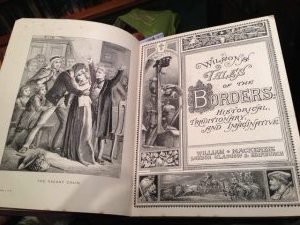
Examples of writing styles from the tales.
There is perhaps no better place to start than the very first tale published, "The Vacant Chair" (by John Wilson). This starts:-
"You have all heard of the Cheviot Mountains. They are a rough. rugged, majestic chain of hills which a poet might term the roman wall of nature; crowned with snow, belted with storms, surrounded by pastures and fruitful fields, and still dividing the Northern portion of Great Britain from the Southern. With their proud summits piercing the cloud,;, and their dark, rocky declivities frowning upon the glens below, they appear symbolically of the wild and untameable spirits of the Borderers who once inhabited their sides. We say, you have heard of the Cheviots, and know them to be very high hills, like a huge clasp riveting England and Scotland together."
The description many of us living locally would have recognised and relished. At the same time as describing them, he also introduced us to his proposition of "the wild and untameable spirits of the Borderers" about whom his tales are to be centred upon.
His analogy of them acting as a clasp riveting England and Scotland together is also an interesting and thoughtful concept and perception of their physical presence.
The tale of "The Vacant Chair" centres around the family of Peter Elliot, a farmer whose farmhouse straddles the Border itself and he knows not whether he was born on the English or Scottish side and therefore mixes the habits of both countries.
Wilson tells us that Peter's speech made him "a living representation of the union: for in one word he pronounced the letter R with a broad, masculine sound of North Britain, in the next line with the liquid burr of the Northumbrians."
We also learn at Christmas time that the English end of his kitchen table roast beef and plum pudding was served, whilst at the Scottish end a savoury and well seasoned haggis, with a sheep's head and trotters, whilst the intennediates space was filled with the good things common to both kingdoms and of the season.
Romance in the tales.
Many of the tales involve romance as might be expected given that the subtitle of the tales was that they were "historical, traditional and imaginative". The trials and outcomes of the romances are as mixed as one might expect in modem literature.
The language is however quite touching and descriptive in places.
"The Sisters" also by Wilson himself tells the tale of two sisters, one whom marries successfully and the other less so.
Of the successful marriage, Wilson tells us:
"She was the world to him, and he all that the world contained to her and often as gloaming fell grey around them, still they
"sit and look into each other; eyes,
silent and happy, as if god had given
naught else worth looking at on this side of heaven!"
As they moved into later life, Wilson tells us:-
"On Helen and her husband, age descended imperceptibly as the calm twilight of the lovely evening, when the stars steal out, and the sunbeams die away, as a wholly stillness glides through the air, like the soft breathing of an angel unfolding from his celestial wings the silken curtains a summer night.. Four score winters passed over them. Their heads became white with the "snow of the years" but they both became old together. They half forgot the likeness of the face of their youth; but still the heart o.f youth, with imperishable affections and esteem, throbbed in either bosom smiling calmly upon time and its ravages: and still, in the eyes of the happy old man, his silver haired partner seemed as young, as fair, and as beautiful, as well, in the moontide of her loveliness, she blushed to him her vows. "
Descriptive imagery I am sure we can all see.
The aging process so dignifyingly described as hair turned white with the "snow of years"!
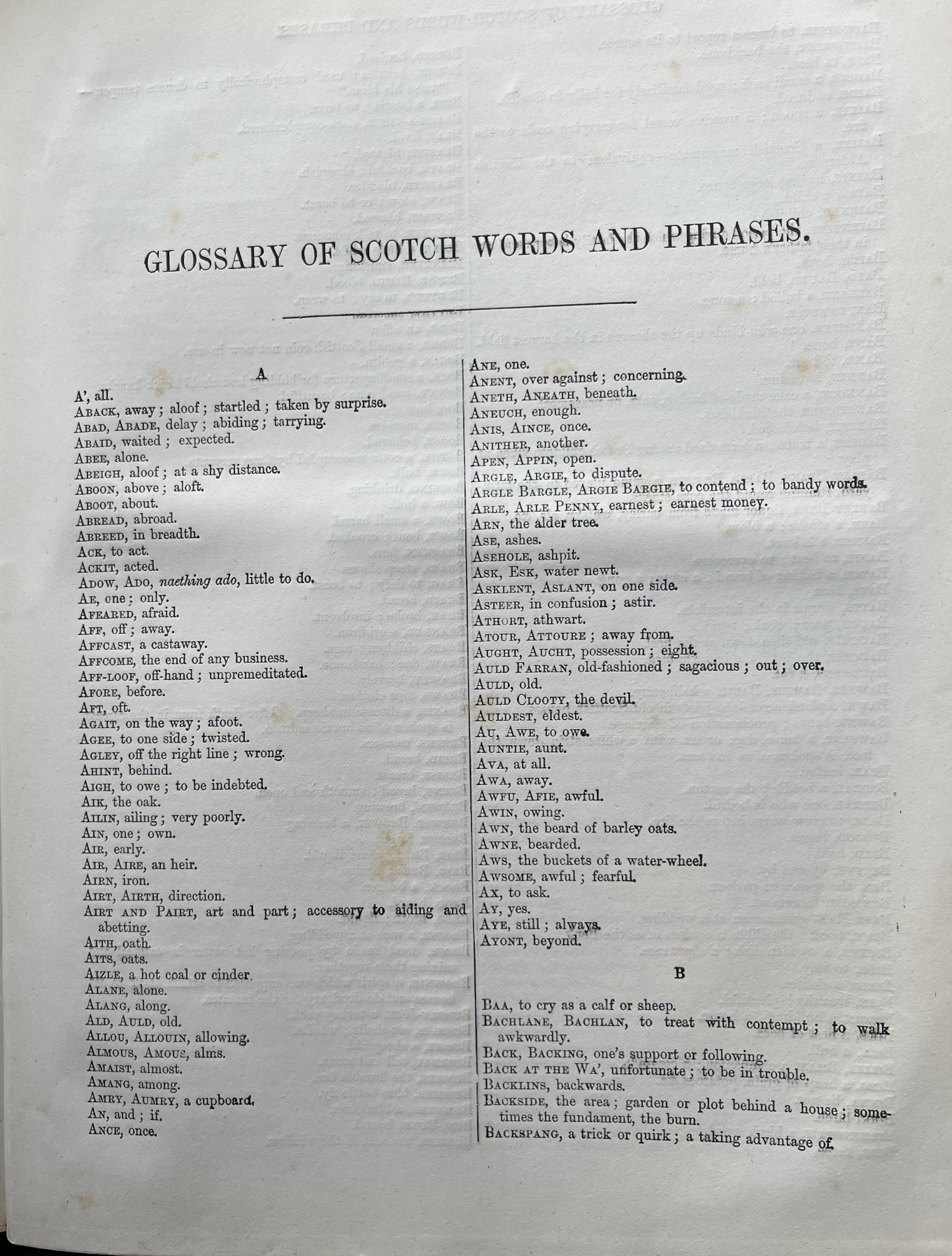 Use of the Scots dialect.
Scots style of writing is prevalent in some of the tales. The "Autobiography of Willie Smith" (by Alexander Campbell) is perhaps a good example. This Tale tells the frustrations, misunderstandings and scrapes that arise when one has such a common name and mistaken identity becomes a feature of your life.
The author laments that his "Faither's name was Willie Smith, may maternal grandfather's name was Willie Smith, I had an uncle whase name was Willie Smith, an' twa cousins whase names were Willie Smith; an' it was determined that I should be a Willie Smith too".
He bemoans his parents hadn't called him "Nebuchadnezzar or Fynackowl, or Chrononhotonthologos, or indeed any name that didn't belong to every third man he met"!
Quoted below is a section from the story when he meets his cousin from Edinburgh:
"He is a ji-ien Here’s a frien o'yours come to see you, fi·ae frae Edinburgh" says the porter, whom I wee/ eneuch kent weel aneuch; and wi' this the young !eddy comes forward, wi 'a licht step, and ane o' the prettiest smiles I ever saw; and, says she, haudin oot her haun to me -
"Ye'll no ken me, Mr Smith I dare say?"
The spirit of the characters.
In many ways the tales capture the spirit of the characters and the undercurrent of their thought processes and outlook on life, which as modern readers we can find of interest. This is social context so often glossed over in high level history but found in abundance in The Tales.
Many Tales relate back to "Reiving" tales and legends and the Border tradition of stealing livestock through audacious raids against neighbours both near and far away. Some of the Tales are about the raids and rivalries these caused and some about the clashes of the last reivers had with the Scottish crown and later authorities as they tried to stamp out the practice and bring more law and order to the Borders.
The Tale of "The Royal Raid" (by Alexander Leighton) tells us how Cockburn of Henderland, near St Mary's Loch was caught red handed by King James V. This despite the efforts of his wife to civilise him to more pastoral occupations. Whilst she tried her best; "she dreaded another outbreak of that daring spirit which she had not yet been able eff'ectively to quell. "
In the "The Faas Revenge", (by Wilson) one of many Tales involving Gypsies, we gain some fascinating insights and some enlightenment of their thinking.
The Laird of Clennell, who clearly considered himself to be a cut above the Gypsy clan orders them from his house as thieves and vagabonds.
To this, the chief of the gypsies takes particular exception. As he sees it, whilst both their forefathers came from places abroad, he commented that the Gypsies merely steal the odd chicken or cow when hungry, whilst the Laird's Norman ancestors had stolen the land itself.sly
The moral element.
The Tales themselves were heavily advertised when originally published and indeed an advert as late as 1887 very much emphasized the "moral tone" of the Tales. An advert announcing the re-issue of monthly volumes in November 1887 tells us:
"There is another peculiarity by which these tales are characterised. which perhaps, more than any other, has contributed to their lasting popularity. Whilst true to history, legend. character and circumstances, their moral tone is such that no father or mother need fear to place a whole series in the hands of their children.
The Tales of the Borders have been immensely popular with the young, and whether we view them in their moral aspect, or as vehicles for instruction and amusement, the collective series forms a repertory of healthy and interesting literature unrivalled in the language. "
Whilst many of the Tales do have moral lessons and, many of them do not have particularly happy endings, the emphasis on their moral aspect was no doubt to give a message that they were suitable reading for the Sabbath!
"The Experimenter" (by John Howell) is perhaps a good example of the message of money and happiness not necessarily being linked.
We learn in the words of the narrator who is the principal character that "my income was small: but my habits were simple and temperate, and my means supplied my wants abundantly." He did however have an inquisitive mind.
We also learn however that his uncle who had gone to the West Indies some years before and returned a wealthy many was pitied by his father. He would say to his brother; "How I pity you! your money is not your own: you are only the gatherer for some other person. You dare not enjoy a shilling, neither can you take it with you when you die:"
Editorial Note:
The Tale of "The Sisters" which I refer to is in early copies of The Tales. Later editions also have a Tale called "The Sisters", however it is a completely different story, curiously.