
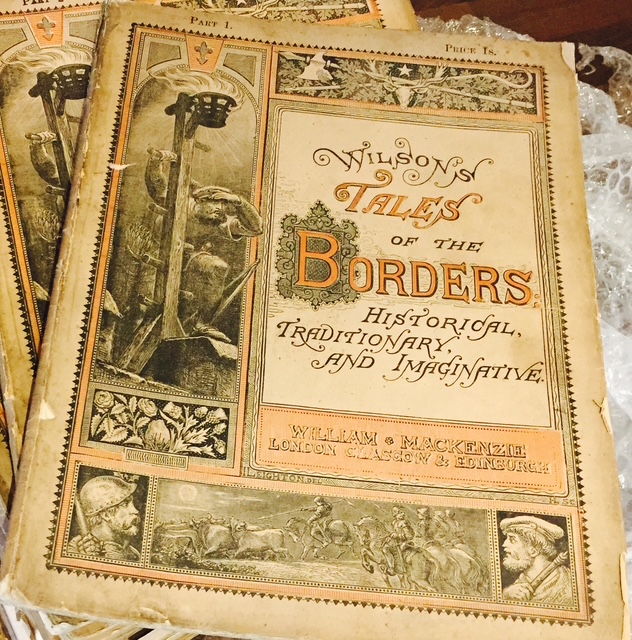
 Wilson’s Tales of the Borders, and of Scotland, Historical, Traditionary and Imaginative, known more commonly as Wilson’s Tales of the Borders are, as their title suggests, a collection of tales, stories, history and ballads, principally of the Borders of Scotland and North Northumberland. An area for many years known as “The Debatable Lands”, as exactly where the Border lay was a rather vague concept to those living there, as was the reality for many centuries, of whether either the Scottish or English crown had any real control over the area.
They were first drawn together and published in weekly instalments from 8th November 1834 by John Mackay Wilson, when he was also editor of the Berwick Advertiser. This was a common method of publishing at the time used by, amongst others, Charles Dickens and Walter Scott.
They became a minor publishing sensation of their day with the original run of 2,000 having to be raised to 30,000 within a year. Wilson was no doubt delighted with this as he had struggled to make a living through various literary endeavours in London and Manchester before returning to Berwick for the more secure appointment as editor of the local paper. Though the salary seemed a bit less reliable than he had perhaps hoped as he complained in a letter to a friend in January 1834: “...the humbugs have jerked me this year and not paid me yet!”
He was not however to enjoy the fruits of his success, dying on 2nd October 1835, less than a year after the first edition, which contained two stories: The Vacant Chair, concerning a farmer, Peter Elliot, who’s farmhouse straddled the Border and who knew not whether he was English or Scottish, and Tibby Fowler a tale of wealth, despair and love winning through to save the day. Wilson had contributed 66 tales to the collection before his death, which was announced in edition 49. He had originally intended to publish 96 editions.
His executors and family continued the process of publication after his death to ensure his widow was not left penniless. They recruited new contributors to continue the publication of these tales. A further 18 identified and 9 unidentified writers added to the collection. A total of 474 tales in 312 weekly editions were eventually published over 6 years ending in 1840, including a wide selection of the rich illustrations that accompanied the tales of love, tragedy and dastardly deeds from not only around Scotland, but of Scotsmen’s adventures abroad covering some 650 years of history.
The largest single contributor was Alexander Leighton, who also went on to edit a 20 part, 10 volume publication of the collected works. Published by William Nimmo of Edinburgh in 1857 this was later expanded to a 24 volume edition published on this occasion by The Walter Scott Publishing Co. Ltd. in 1869.
Many of the tales are themselves snapshots of history and contain a rich collection representing a period of 650 years of our social history, heritage, lore and legend. They were subtitled “Historical, Traditionary & Imaginative”, some being more at one end or the other of this scale. They caught the imagination of the their age and deserve to be given new life to entertain and educate a new generation.