
Wilson’s Legacy
The Trade Unionist and founder of the Labour Party Keir Hardie stated:
I think my mother’s songs made the strongest impression on me, combined with the tales and romances of my grandmother. The first book I remember reading was “Wilson’s Tales of the Borders” and these took a hold of my imagination and created within me a love of the tales and traditions of Scotland and of other countries which abide with me still.
(from the Weekly Chronicle 29th May 1934)
Wilson’s 73rd Tale, The Minister's Daughter, had included the statement “concluded next week”, but Wilson did not live to see it published as he died on October 2nd, 1835. His customary political article had not appeared in The Berwick Advertiser on the 19th of September and a number of newspapers reported that he had taken ill two weeks before his death, as follows:
About a fortnight before this unfortunate result Mr. Wilson burst a blood-vessel, and from that period gradually sunk under the effects of that accident, although his medical attendants and friends by no means imagined his end to be so near.
One newspaper reported that his last words were:
The hour of my departure's come,
I hear the voice that calls me home;
At last, O Lord, let troubles cease,
And let thy servant die in peace.
On 3rd October 1835, his death was announced in the Advertiser. This obituary suggested he had been ill for longer. It reads as follows:
This morning, in the 31st year of his age, and after an illness of three weeks, Mr John M Wilson, during several years editor of this journal, and author of various compositions in prose and poetry, which are familiar to the public. Mr W. acquired the status in society which he occupied at the time of his decease by dint of his own exertions; and thus added another to the honourable examples of persons who have overcome difficulties and bettered their condition in the world. His efforts in the cause of Reform will be remembered long. To facilitate the progress of liberal opinions on subjects both of general and local interest was the constant aim of his editorial labours; and to every movement in this quarter, which identified itself with the liberties and comforts of the people, he lent a strong impulse by his presence and powerful appeals.
The newspaper also published the following unattributed poem (his brother James published poems so perhaps by him):
ON THE DEATH OF JOHN M. WILSON
Again the death-bell strikes mine ear;
It sounds so sad and slow,
Methinks in each deep toll I hear
The voice of mortal woe.
But oh! If thus that sound has power
The careless heart to wound,
How must the new-made widow’s soul
Shrink from its dismal sound!
The Border star is set to-day,
Gone down, alas! at noon;
And all are sad – the very sky
Has wrapp’d itself in gloom.
Long time the tree in weakness stood
And bow’d to every blast;
But yet it broke not, and in strength
It rear’d its head at last:
I mark’d its beauty, and its height
Aspiring to the sky.
And thought, the time will come when thou
Must lay thy glory by.
Even while I gaz’d the storm came on,
The lightnings flashe’d around –
Its beauty blasted, broke its boughs,
And bent it to the ground.
The whirlwind next, with raging force
And death-like fury came;
It pass’d and left the stately tree
Uprooted on the plain.
Low lies the pride of Tweedmouth now,
The Borders well may mourn;
Their champion’s gone where many go, -
Whence none can e’er return.
In your churchyard another grave
Is added to the throng –
Say, who beneath that new - turned sod
Now dwells the dead among?
Of birth obscure – yet one for whom
Now many a stranger weeps;
For know, that under that cold turf
JOHN MACKAY WILSON sleeps.
Similarly, J. Proudfoot wrote his Lament to John Mackay Wilson a few days after his death. The following is an extract:
Alas! he is gone in the zenith of the glory -
His genius was fertile, his loss we deplore:
He gladden’d the hearth with traditional story
Alike cheer’d the castle, and the cot on the moor.
One can only speculate as to the cause of such a sudden death. In 1832 Wilson had stated that his health was concerning him and he may always have had health problems. The work-load he assumed from March 1832 until his death can not have helped.
It has been suggested that he had a problem with alcohol which could have damaged his health. Though these seems unlikely as he lectured on the benefits of temperance! Andrew Ayre (2018) believes he may have used opiates to enable him to work so hard. This is certainly possible and interestingly Tait in his biographical notes regarding Wilson states:
… the strain during the summer of 1835 was too much. Artificial aids to exertion might sustain the powers for a time; but the collapse was all the more certain to appear.
Opiates were legal and used by many creative people. Scott used laudanum and opium. Famously when de Quincey used opium he experienced “nightmarish visions” and Samuel Taylor Coleridge wrote of the “caverns measureless to man” during his experiences of opium usage.
The publication of The Minister's Daughter, which had been advertised in the Advertiser, was organised by Rev. J. K. Campbell, then of the Tweedmouth Church of Scotland, who included the following announcement in the forty-ninth edition of the Tales:
It is our painful duty to send around the land the tidings of the lamented death of Mr JOHN MACKAY WILSON, the author of these Tales. This event has come upon us at an hour when, in truth, ‘we looked not for it’. That grim messenger, whose afflicting visits he has so often affectingly described, has borne his irresistible demand upon him – thrown the gloom of desolation over the bright scene that was expanding before his eyes – and left, in darkness and in sorrow, his bereaved and afflicted friends.
The event which we thus deplore, took place on the morning of the 2nd instant. Thirty–one short years only had rolled over him in this vale of tears. His sun had not yet gained its meridian splendour, when the dark cloud of death overshadowed him, and has left us to look after him in sadness across that bourn no traveller ever returns.
Wilson, who left a wife but no children, was buried in Tweedmouth. According to Bellas Knowles (cited in the Berwickshire News and General Advertiser of 5th January 1909) at the graveside ceremony an irate young woman flung an issue of the Tales at Wilson’s coffin and shouted “Here. Tak yer lees wi ye”. It is thought that she believed her father to have been the subject of one of his Tales (Yates 2010).
A small service was held at the graveside on the anniversary of his birth in 1927 when a wreath was laid. Similar ceremonies were subsequently conducted annually for some time and on the anniversary of his death in 1935, following a service, the then owner of the Berwick Advertiser, Major H. R. Smail, made a speech and laid a wreath, as did the then Editor, J. M. Friar. Earlier it had been suggested that a memorial to Wilson should be erected in Tweedmouth itself, but no such memorial exists. In 1905, however, a brass plaque by Gosselin of London was displayed in the Scottish church in Tweedmouth and is now in the possession of the Wilson Tales Project.
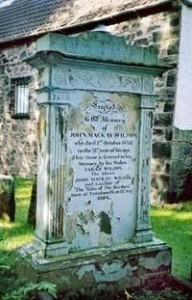
The Wilson Memorial in Tweedmouth Church Cemetery
Wilson had originally intended to publish 96 editions of his Tales but, he died as the 49th edition was about to be published. That edition included the following appeal on behalf of his widow who had “shared his sorrows through many a changing year”:
He has left a widow respectable and respected; and, from what we have said of his struggles through many a dark year, she is left to depend on the profits of his works for the comforts necessary for her, till she sink to rest with him in the grave. Nor are her prospects dark if those who cheered him on in his literary labours still stand by her. His materials are not yet exhausted, and “tales yet untold” are in reserve to keep alive his memory and soothe as far as earthly comforts can her widowed heart … Under the management of Mr James Wilson, her brother-in-law, and Mr Sutherland of 12 Calton Street, Edinburgh, who is now publisher, we trust to see her reap the full reward of his genius and toil whose last hours she sweetened.
On 10th October, only a week after Wilson’s death, the following advertisement was published in the Advertiser and elsewhere:
… the Border Tales for the future will be published for behoof of the Widow of John Mackay Wilson, Berwick, by John Sutherland, 12 Calton Street, Edinburgh. From the Steam-Press of Peter Brown, Printers, Edinburgh. Stereotyped by D Stevenson.
The Newcastle Courant of 21st September 1835 was generous in its editorial about the Tales and the predicament of his widow, thus:
WILSON'S TALES OF THE BORDERS. To an imagination so lively, and powers so versatile, as those possessed by the late John Mackay Wilson, the long history of the English and Scottish borders presented a fertile field from which to gather a series of Tales, such as those now in course of publication. Probably most of our readers have seen occasional numbers of the work; and so feel pretty well assured, the more they see the more they will be gratified. We know of no other publication in this district which, from its cheapness and agreeable a reading, is better adapted to be taken by a few neighbours, and circulated weekly among them. Old and young would alike derive pleasure from its pages, at the same time that they would steer clear of the pernicious effects which many other books that are pleasant reading have a direct or remote tendency to produce. Let it be remembered, too, that in purchasing these Tales, they are engaged in a work of charity-in the support of the widow of the author, whose premature death left her only the memory of his merits as her consolation, and these Tales as her only legacy.
The advertised appeals on behalf of the widow continued for a number of years and an example is presented below.
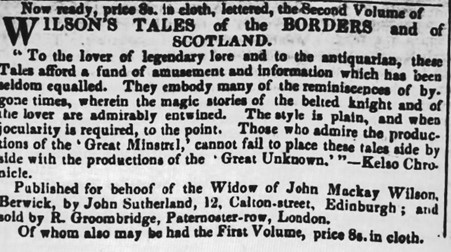
From The Globe 20th October 1836
As noted above, in the 49th edition of the Tales it was suggested that Wilson left a considerable amount of material. Tait however states:
There was not a leaf of manuscript to be found.
Thus, if publication of the Tales was to continue other writers needed to be recruited. Sutherland appointed Alexander Leighton (1800-1874) as Editor and story-writer. He was from Dundee and had studied medicine at Edinburgh University and had worked at a law office in Edinburgh before turning to literature.
Leighton considerably expanded the work, adding many tales from other sources, including Hugh Miller, Thomas Gillespie, Alexander Bethune and his brother John and John Howell. The Newcastle Daily Chronicle of 25th May 1863 included the following advertisement for Wilson’s Tales:
Ainsworth and Ward and Lock, London 1 shilling per volume, 280 pages in each volume.1863
Tales of the Borders. VoL 1. London: Ward and Lock. The Tales of the Borders had an
unprecedented circulation when first published. Deficient in elaborate finish and highly-wrought plots, they yet maintain their place in the affections of the generation now growing old, that made acquaintance with them in their early form. Stray volumes of these tales have for twenty years added to the pleasures of youth, and it will therefore a cause of gladness for that class of readers to meet with a re-publication of the whole work in shilling volumes. Ten of the tales appear in this first volume. Among them are Hugh Miller’s “Recollections of Ferguson,” and two of Gillespie’s Professor's Tales. Writers whose names afterwards became famous, co-operated with the enterprising editor, the late John Mackay Wilson, in this still stupendous and then unique work. In the words of the modest preface—“ The only condition by which the natural promptings might have been restrained was that the contributions should be genuine stories, with such an objectiveness as would portray, graphically and naturally, the men and women of the times acting on the stage whereon they were destined to perform their strange parts, and would exclude all false colourings of sentimental fiction belonging to mere subjective moods of the writer’s fancy feeling. The greatest care was also taken with the moral aspect of the tales, with the view that parents and guardians might feel a confidence that, in committing them into the hands of their children and wards, they would be imparting the means of instruction, and, at the same time, securing a guarantee for the growth of moral convictions”.
The Tales changed in character when Leighton took over. The stories were no longer confined to the Borders, but came form all over Scotland and the exploits of Scotsmen around the globe.
Tait comments:
… there can be no doubt that, though the work proceeded as before, and probably maintained its popularity, its character and aims gradually diverged from the original intention; and from Tales having only a remote connection with the Borders, the transition was easy to many in which violence was done to the sequence and consistency of the story, by introducing something which might justify its appearance in a series of Border Tales. Many of the best stories consequently make no pretension to conformity with the title under which they appear. Indeed it may be said that towards its close the publication assumed more the character of a weekly novelette, in which, however, the moral tone and excellence were always well sustained ... producing what undoubtedly is the most interesting collection of Tales and Romances descriptive of Scottish life and character which we possess. What was thus a loss to the Borders was a corresponding gain to Scottish literature generally; and the popularity which the “Tales of the Borders” have so long maintained is doubtless due to what we may call the national rather than the local character they ultimately assumed.
Sutherland was over-confident about his ability to make the production of the Tales a success. Tait writes:
Sutherland was so sanguine about the Tales of the Borders, that he went to the expense of having all the numbers stereotyped; and the plates became so bulky, that he was compelled to erect a small building behind the shop for their preservation.
His business eventually ran into difficulties. Tait continues, thus:
The stereotype plates and copyright were sold, and the Border tales thus found their way into the hands of Messrs Ainsworth publishers, Manchester, who more than once issued full sets, printed from the plates, with the original plates deleted.
The Tales continued to be enormously popular in the 19th Century with dozens of editions. In publishing his own edition in 1881, Tait makes the following claim:
… no book has been produced in recent times which has been at once so popular with all classes of the community, and which so thoroughly identified itself with the thoughts and feelings of its readers. By the high moral tone and varied interest, it found its way to the hearts and homes of Scotsmen in all parts of the world. For years it formed the staple source of amusement around many a cotter’s fireside; its weekly issues were waited on with impatience and read with avidity; and even yet after the lapse of nearly fifty years, there is probably no work to which a Scotchman will turn more readily, to while away a leisure hour, than the old but ever-new ‘Tales of the Borders’.
Of course, tastes change. Wilson’s views on poetry as expressed in The Enthusiast were not original or especially stimulating and his writing style was of its time. The poetry is no longer popular and thus The Enthusiast is long out of print. The language of the Tales now seems similarly old-fashioned and the stories often involve unlikely plot twists which are not to the taste of modern readers. Even an advertisement from 1863, cited previously, states the Tales are:
“Deficient in elaborate finish and highly-wrought plots”.
Prior the Wilson’s Tales Project’s publication of Revival Editions the last publication of Wilson’s Tales was in 1947 by The Ettrick Press. It’s publication stated:
“it is perhaps less true today than it was 20 years ago that the library of every country cottage consisted of the Bible, Burns, the Scotts Worthies and the Tales of the Borders, but it is still true enough to possess significance and deserve note”.
Despite coming from humble origins and leaving school at a young age Wilson achieved a great deal in his short life. His determination to succeed and his work-ethic were impressive. As Rev. Campbell states in the introduction to the Tales of the Borders, Number 48:
Despair seemed an entire stranger to him; and the strength of his own mind stayed him amid darkness and amid tempests.
In all his work his standard of literacy is excellent and he displays a remarkable knowledge of literature, politics and history.
In pursuing a literary career he was confident of his own abilities and not shy in promoting his work, in 1829 he wrote to the Advertiser regarding his poems
If a man does not speak well of his own wares, whom does he expect to do it for him, when every person is busy selling wares of his own.
“Health and home are powerful magnets”.
The exile returned home, but success came too little, too late.
References:
Ayre A. (2018) Wilson’s Tales of the Borders – Revival Edition 5 The Wilson’s Tales Project
Yates M. (2010) John Mackay Wilson and his Tales of the Borders on-line
Fraser M BA MSc MPhil (2018) “Health and Home are Powerful Magnets”. An Exile returns to Berwick.